
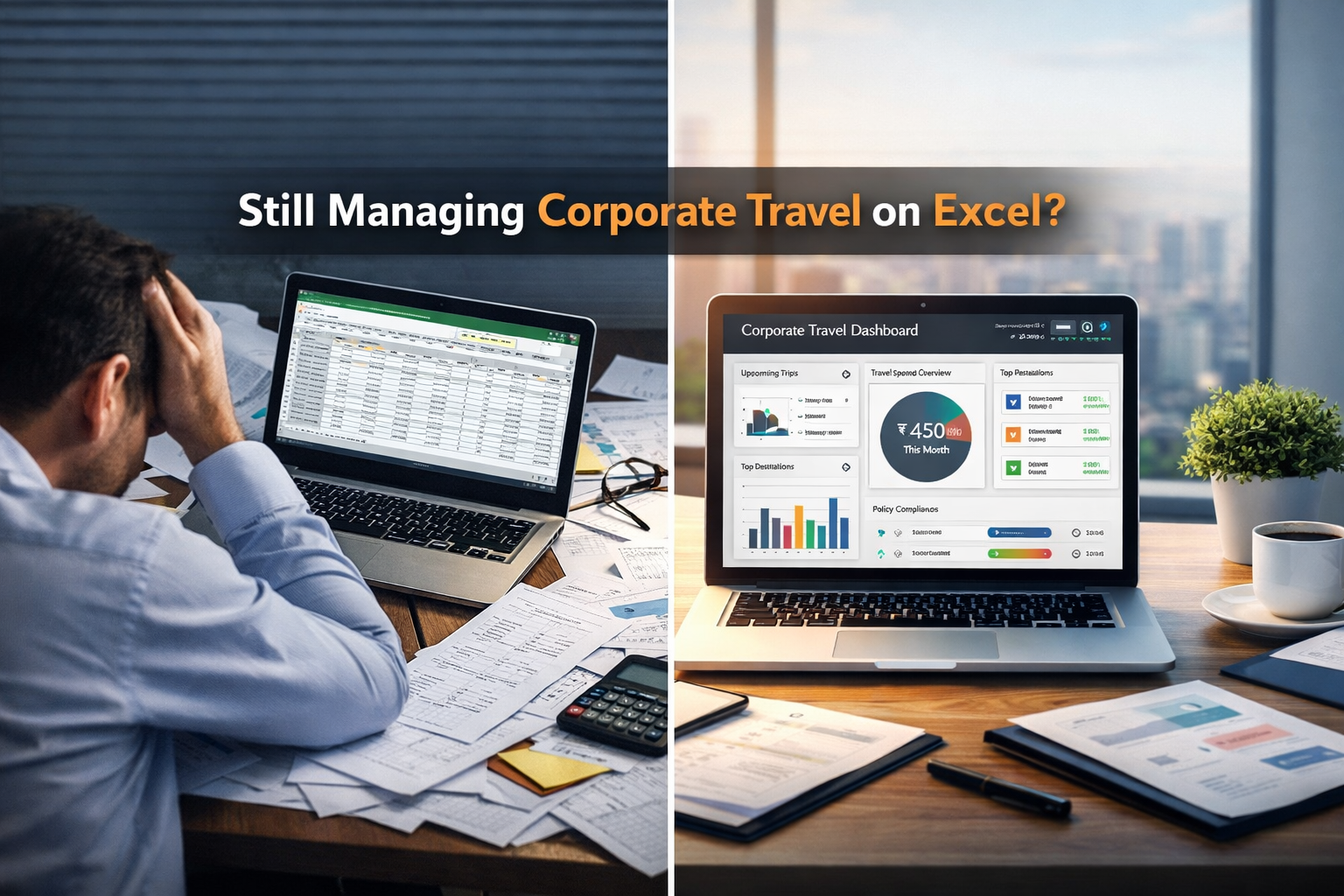
For years, Excel has been the quiet backbone of corporate operations. Budgets, headcount planning, vendor databases — everything eventually finds its way into a spreadsheet. So when it comes to managing corporate travel, many organisations naturally rely on Excel to track requests, approvals, and expenses. It feels organised. It feels visible. It feels controlled.
But corporate travel today is no longer a static administrative task. It is dynamic, price-sensitive, policy-driven, and deeply connected to both employee experience and financial governance. And that is where spreadsheets begin to fall short — not dramatically, but gradually. The problem isn’t that Excel doesn’t work. The problem is that it works just enough to hide the inefficiencies it creates.
At first, the system seems manageable. Travel requests arrive via email. Someone logs them into a sheet. Approvals are marked manually. Vendors send quotes. Costs are updated after booking. Finance reviews the file at the end of the month. On paper, everything appears documented. But what looks structured on the surface is often operationally fragmented underneath.
The real cost of Excel-based travel management rarely appears as a line item. It shows up in time lost. In delayed approvals that push ticket prices higher. In back-and-forth email threads comparing vendor quotations in different formats. In HR teams spending hours coordinating instead of focusing on strategic priorities. When travel volumes increase, these manual touchpoints multiply quickly. What once felt like a simple tracking mechanism becomes a coordination burden.
Another overlooked issue is that spreadsheets are reactive. They record what has already happened. They don’t prevent policy violations before a booking is made. They don’t automatically flag out-of-budget requests. They don’t restrict choices based on company travel rules. By the time a discrepancy appears in the sheet, the transaction is already complete. In growing organisations, this creates quiet budget leakage — small deviations that compound month after month without immediate visibility.
Vendor fragmentation adds another layer of complexity. Many companies use separate partners for flights, hotels, ground transport, and offsites. Each vendor communicates independently. Each quotation arrives differently. Each invoice is reconciled manually. All of this information eventually lands in Excel, but the system itself does not unify it. Without a centralised view, organisations lose consolidated negotiation power and consistent reporting. Fragmentation increases coordination effort — and coordination effort increases cost.
There is also a strategic gap that spreadsheets cannot bridge: insights. Modern travel management is not only about booking efficiently; it is about understanding patterns. Which departments travel most frequently? How often are bookings made last minute? What is the average cost per trip? How much could be saved through structured approvals or advance planning? Excel can store numbers, but it cannot automatically interpret behaviour. Without analytics, travel remains a cost centre instead of a controllable function.
Compliance and audit readiness are equally important. Manual systems increase the risk of invoice mismatches, missing documentation, and version confusion. As organisations scale, even small administrative inconsistencies can become significant operational concerns. Excel relies heavily on human accuracy and manual updates. In fast-paced environments, that reliance introduces risk.
The deeper issue is not technology — it is mindset. Many companies continue using spreadsheets because they are familiar. Change feels disruptive. Systems feel expensive. But what often goes uncalculated is the cost of inefficiency. The hours spent chasing approvals. The premium paid on last-minute fares. The duplicated effort across departments. The absence of real-time oversight. When these factors are added together, the perceived “low-cost” solution becomes surprisingly expensive.
Corporate travel today sits at the intersection of finance, HR, operations, and employee experience. It influences productivity, budget control, compliance, and even employer branding. Managing such a function through static spreadsheets may seem practical in early stages, but as organisations grow, the limitations become more visible. Scale demands automation. Visibility demands integration. Cost control demands proactive systems rather than reactive records.
The question organisations should be asking is not whether Excel can handle travel management. It probably can — for a while. The real question is whether it is still the right tool for a function that has evolved in complexity and importance.
Sometimes the most expensive systems are not the ones you invest in. They are the ones you continue using long after you’ve outgrown them.