
For a long time, corporate travel was treated as a back-office activity. Someone needed to fly to another city, a ticket was booked. A hotel was arranged. An invoice was filed. The job was considered done. Travel lived quietly within the admin function, seen as a logistical necessity rather than a business lever.
But the corporate environment has changed. Companies are scaling faster. Teams are more distributed. Offsites are intentional. Sales travel is measured. Investor meetings matter. Hiring across cities is common. Suddenly, travel is no longer just movement — it is momentum.
And momentum affects performance.
The way organisations manage travel today has a direct impact on cost control, employee productivity, compliance, and even culture. Yet many companies still operate with outdated systems that treat travel as a reactive task rather than a structured function.
The difference between administrative travel management and strategic travel management lies in control and visibility. When travel is handled through scattered emails, spreadsheets, and disconnected vendors, the focus remains on execution. Book the ticket. Confirm the hotel. Process the reimbursement. But execution alone does not create efficiency. Without real-time visibility into spending patterns, approval behaviour, and vendor performance, companies are simply processing transactions — not managing outcomes.
In growing organisations, travel budgets are no longer small operational expenses. They can represent a significant portion of annual spending, especially for sales-driven teams, consulting firms, tech startups expanding across markets, or companies investing in team engagement through offsites. When spending reaches that level, leadership begins asking deeper questions. Where is the money going? Are we booking too late? Are we staying within policy? Which departments travel most frequently? Could structured approvals reduce last-minute premium fares?
These are not administrative questions. They are strategic ones.
Another shift that has transformed corporate travel is the focus on employee experience. Travel today is not just about reaching a destination. It shapes how employees perceive the organisation. Smooth booking processes, clear policies, and well-managed itineraries reduce friction. Chaotic coordination, last-minute changes, and reimbursement confusion increase stress. In competitive talent markets, experience matters — even in business travel.
There is also the governance factor. As companies scale, financial discipline becomes more critical. Manual processes make it difficult to enforce travel policies consistently. Without embedded approval hierarchies or automated controls, deviations become common. Over time, small inconsistencies create larger budget drift. Strategic travel management, on the other hand, integrates policy enforcement directly into the booking process. Decisions are guided before spending happens, not after.
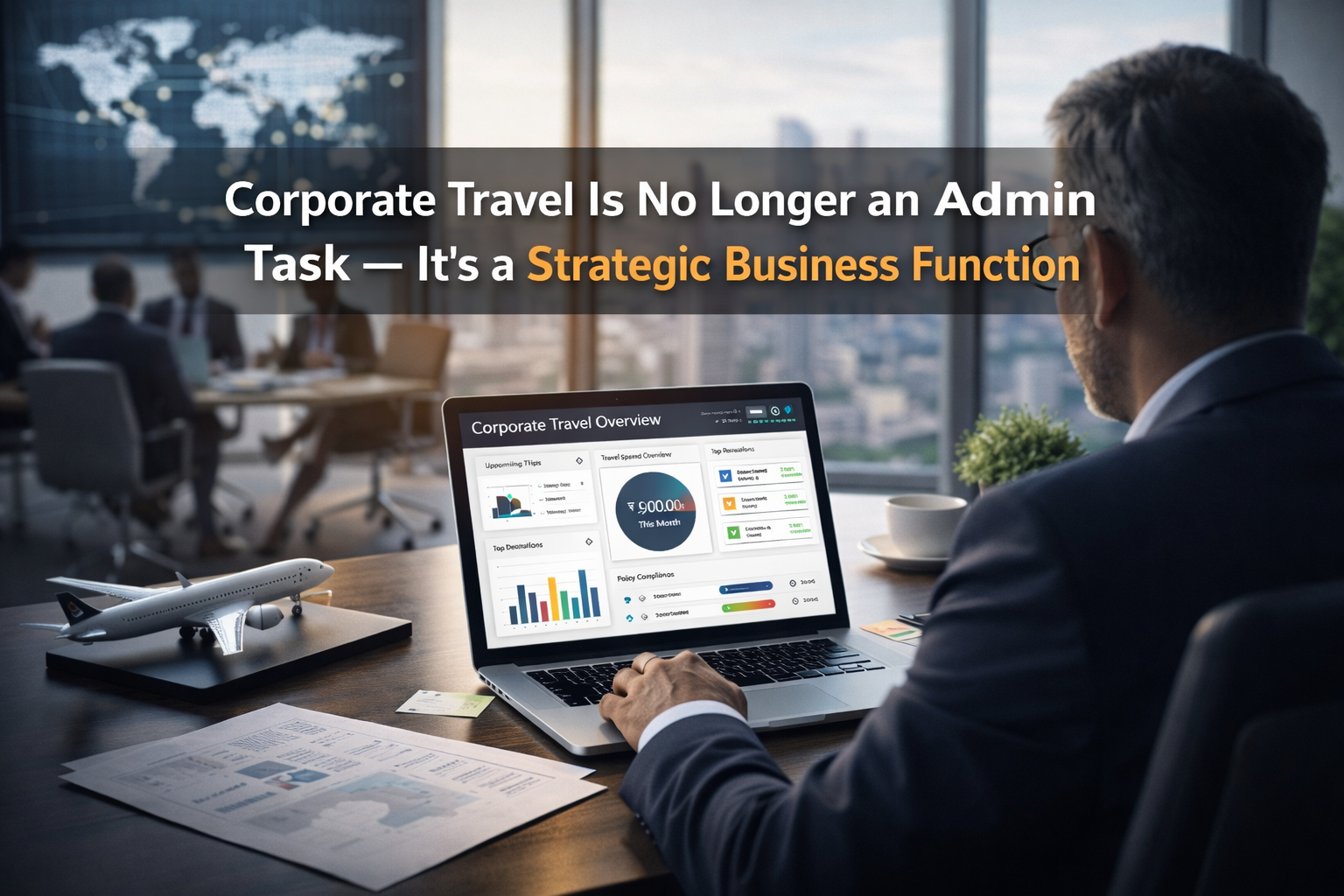
Perhaps the most significant difference between administrative and strategic travel management is data. Modern organisations rely on dashboards for almost every function — sales performance, marketing campaigns, hiring metrics, operational efficiency. Yet in many companies, travel data remains buried inside spreadsheets. When travel information is not centralised or analysed, leadership loses the ability to identify patterns, optimise vendor negotiations, or forecast future budgets accurately.
A strategic approach treats travel as a measurable function. It connects bookings to budgets. It tracks trends over time. It highlights inefficiencies before they compound. It turns reactive coordination into proactive planning.
This shift does not mean travel teams suddenly become analysts. It means the systems supporting them evolve. As processes become automated and integrated, HR and admin teams spend less time chasing approvals and more time focusing on initiatives that drive organisational value. Finance teams gain cleaner reporting. Leadership gains clarity. Employees gain smoother experiences.
The mindset change is subtle but powerful. Instead of asking, “Has the ticket been booked?” organisations begin asking, “Are we managing travel effectively?” That shift in question transforms the function entirely.
In a business environment where cost optimisation, compliance, and employee engagement all matter simultaneously, travel cannot remain a side task. It touches too many strategic areas. When structured correctly, it becomes a lever for efficiency rather than a source of friction.
Corporate travel is no longer just about moving people from one place to another. It is about supporting growth, maintaining discipline, and enabling performance across teams and geographies.
The companies that recognise this early move away from fragmented systems and reactive processes. They invest in structured platforms, integrated workflows, and real-time visibility — not because it looks modern, but because it creates measurable control.
The real question for leadership is simple: Is travel in your organisation being managed as an operational chore, or as a strategic function?
Because in today’s business landscape, the difference matters more than ever.